

Architecture equips organisations with the structure and insight to understand strategy, operations, and implement change. Combined with ethical principles, it supports decisions that go beyond compliance to create real societal value. As artificial intelligence (AI) becomes central to organisations, architecture provides the foundation for Responsible AI—aligning technology-driven change with ethical and governance principles.
This post explores how architecture can embed ethics across the business and technology lifecycle, sharing practical lessons from programmes addressing automation, data use, and resilience. It demonstrates how an architectural mindset makes Responsible AI tangible—ensuring innovation is trustworthy, transparent, and aligned with organisational purpose.
 Café Associates was engaged by the City of London Police (CoLP) to provide architectural support for a major transformation programme. Café was part of the core team working across the full lifecycle from inception to delivery, providing an architecture-led approach at procurement phase and then continuity of expertise through to full go-live of the new national Report Fraud service in December 2025.
Report Fraud uses an end-to-end data platform that allows information from victims to be handled by experts in reporting and victim services, and to be made quickly available and easily accessible to crime and intelligence specialists. The procurement pack was developed in close consultation with subject matter experts at CoLP and used to steer the bid process through to contract award. Large public sector procurements take time to follow agreed procedures and the requirements are intended to be high-level and outcome-oriented to allow prospective partners to propose innovative solutions.
AI as a business requirement
In 2021 when the procurement pack was built, Large (or even small) Language Models (LLMs/SLMs) hadn’t made it into the mainstream media. It was only when the first GenAI offerings were made available for public consumption that we had an indication of the capabilities that might result.
Nevertheless the high level requirements anticipated the opportunity of advanced data analytics arising from Artificial Intelligence/Machine Learning (AI/ML) and the use of Natural Language Processing (NLP) to assist, especially given the unstructured data – much it verbal/textual – that is inherent in victim reports.
Moving through to 2024/2025 when LLMs become almost commonplace, the handful of use cases identified for early implementation were largely a matter of configuration of the products selected during procurement.
Architecture across the Programme/Product Lifecycle
The role of the architect across this lifecycle has been to help CoLP and the business leads assess the feasibility and prioritise these use cases, navigate the new capabilities from process and information viewpoints as well as consideration of the ethical aspects. Use of AI within policing has received adverse press especially in the area of Live Facial Recognition (LFR). It has made the news in 2026 with extensive public scrutiny, although the first use of facial recognition at the Notting Hill Carnival made the press back in 2017 (possibly before). It is imperative therefore that we balance competing demands and public perception, as novel technologies are introduced.
The author of this post presented a paper entitled Architecture, Ethics and Responsible AI – Trustworthy Capability in April 2026 at the Building Business Capabilities conference in Toronto Canada and a similar session at the Enterprise Architecture/Service Design conference in London in June 2026. The conference paper covers the need for architects to support organisations across the lifecycle to adopt AI in a responsible manner and apply appropriate risk-based assessments through well-defined governance. That’s typically what architects do, this isn’t new although applied to AI. This is especially high profile and architects need to be up to speed with thinking about ethics.
We aren’t short of AI frameworks, standards and risk management tools. They need to be adopted and adapted to meet the business need. Some of the the key considerations when embarking on adoption of novel technologies like AI in policing are outlined below
- there is an imperative to balance ambition, capability and confidence. This determines pace of delivery, which must be in step with government and public appetite
- governance arrangements have to be robust and this is ideally harmonised across UK policing. This is coming but not fully established so local practices are having to be put in place
- business and technology teams need to have a mutual understanding – AI literacy improvements are needed
- practitioners are keen to explore further use cases and this has to be benefits driven
Data ethics assessments
For each of the initial use cases for Report Fraud around speech analytics and text summarisation, data ethics assessments were conducted. The approach take built on the foundations of Data Protection Impact Assessments (DPIAs) already in place.
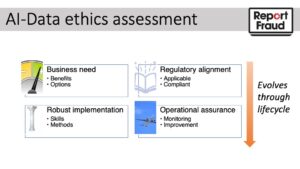
The findings of these assessments highlighted positive areas that helped build confidence and trust but also areas of concern. These were largely around lack of design detail and especially transparency, which required a lot of probing. Also as expected the product assurance techniques for services and products using AI are still in their infancy. Not surprising in a fast moving area such as AI.
Key Takeaways